06 April 2014

longing for leaves

In the Scandinavian part of the world, there really aren't many plants for the dyeing pot during the long winter months. Dried and frozen, of course, but I'm not much into that. Besides blackberry leaves (as I mentioned in the previous post),  there's bark and cones and different peels and skins.

Red onion skin (no mordant) on wool, silk and cotton

Shibori attempt on old silk skirt - dipped in oak bark & rust water

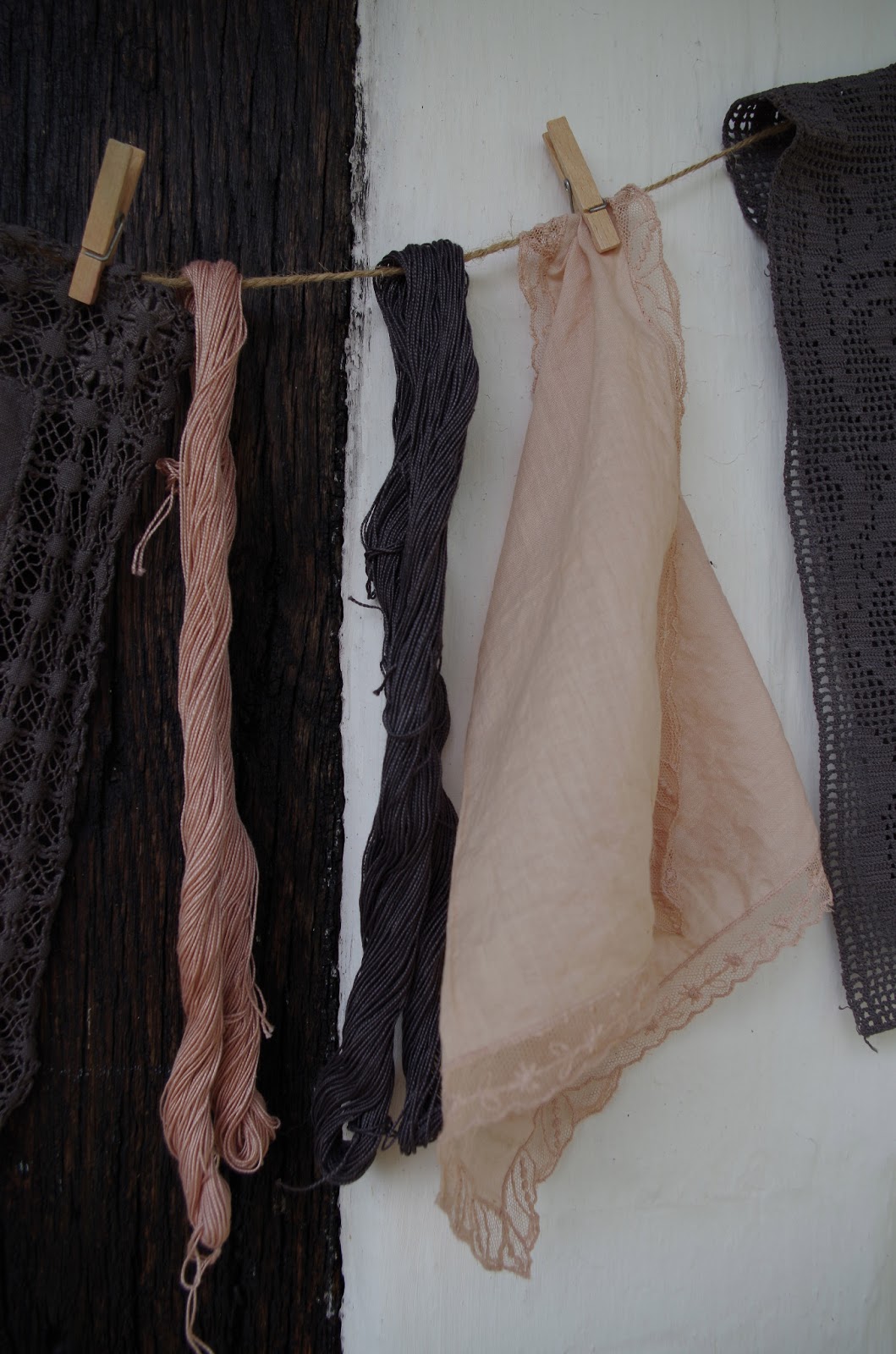
oak bark (grey), spruce cone (left) and avocado skin (right) - no mordants


 Different kinds of bark (cherry, oak, elm), spruce cones & onion skin
on cotton (crochet) yarn

 Cherry bark soaking - aluminium pot & solar dye (last summer)

Some of the yarn I dyed last summer. The greens are black hollyhock, the reddish are curly dock roots and chestnut peels, yellows different sorts of bark & flowers.

Actually, waiting for leaves to emerge is perfectly all right - at some point a creative human being must do something with all that wool and dyed yarn. Yarn spun with wool from Vega the Bunny mixed with some lamb wool. The yellow comes from dyer's chamomille flowers.

20 March 2014

tasmanian devil & easter socks

I had a bit of luck rummaging the local secondhand store; a tasmanian wool cardigan, never worn, just a tiny hole that needed mending. Gathering dyeing material in February isn't exactly the most thrilling experience, but using what is a hand (seeing the potential where you think there is none) is fun. Blackberry leaves were still plentiful, and I had some dusty smoke bush twigs forgotten in a corner of the scullery. I also found a rhubarb stalk with seeds - and a quick sweep of the floor in the barn, where Nissen slept during Yule, provided me with some dried spruce needles (in company with some dust bunnies and whatnot). I'm not particular, so I used it all.


Easter socks: placed red onion skins in the socks, rolled them up and dumped them in a jar with some avocado skin and chopped up pit, a spoonful of ash from the mass oven, covered with water and placed in a windowsill for a few weeks. Looking a bit like easter eggs. I shall dance in them if I'm invited to a grand easter party!

19 March 2014

fermenting indigo the natural way

For many years, I was happy and content dyeing with plants found practically under my feet. Sometimes, when studying dusty old dyeing books, I saw intimidating indigo recipes, which required purchase and use of chemicals I couldn't pronounce, and even less understand the effects and consequences of. So I didn't make blues, even though it's a favourite colour of mine. But didn't care that much, really, there's a big world of colours, besides blue.

There's a time for everything. The blues started growing in my own garden, and then I just had to go with the flow. A new world  opened up to me through the japanese indigo, and now I've even begun flirting with the 'real thing'. There are - and has been, for generations and generations - ways of fermenting indigo, that are not harmful to the environment. It's like fermenting food, just a tad more smelly

Above is a vat I started approximately 2 weeks ago, and since then it has come alive and developed a copper film on top of the vat, standing on the warm bench of our mass oven. The recipe is from here; and it goes as follows:

· 50 grams of finely ground indigo

· 28 grams finely ground madder root

· 28 grams regular old wheat bran (I made it by milling and sifting some grain of wheat)

· 170 grams washing soda

After mixing the ingredients and placing the bucket (with lid) a warm place, all you have to do is gently stirring once a day.
  
Some of the initial testings - oh, the possibilities, I'm so looking forward to play with this ...


A simple ami shawl and hat (modified with a crochet rim) made with homegrown
 japanese indigo.


30 January 2014

another way of sowing seeds

Some of the best natural dye students are under the age of five. Seriously; how many grown up students jump up and down and hug you, when you tell them it's time to unwrap a bundle? I'm so delighted with their pure joy and exitement - collecting leaves and flowers become an adventure, there's no hesitation when designing - they know exactly what they want to do and where to place what, having no clue at all what they're doing (I'm learning something here). The exited, yet ceremonious way they unwrap the bundles - and the unabashed pride and pleasure with the result. And they have no problem wearing their natural dyed underwear on the outside - and really, why shouldn't they?


My small 'students' already know a lot about plants; edible as well as dyeable. Quite a lot more, that many a modern grown up, I dare say. And they are not afraid to move one step ahead by themselves, trying out new things. The grey trousers above was a result of the imagination of a 4 year old. He was cutting down an offset from a stump, wanting to carve some hooks from it - when he got the idea to use the bark for dyeing (clever little guy!). Naturally we tried it - and got a pretty grey with a brown tinge (with a dip in rusty nail soup to deepen the colour). But what's even more important than the lovely things they make, are the seeds growing inside them: seeds of love and respect for Nature. Seeds, that are nurtured by getting to know her better, by learning about the gifts she offers, and by learning to appreciate her beauty. That's also what natural dyeing is all about for me; seeds of love!

29 October 2013

The Quiet Revolution


Some time ago I stumbled upon a amazing blog, a magic place of creations, with stories for both eye and soul. I don't remember how I got there, but presumably by forces of moon and stars, more than numbers ticking away on the electronic web. A gate-builder between worlds, and multi-talented artist is she, Rima Staines, and you can find her blog here.


What caught my eye back then, was this symbol, a wheel with rooted tree-people with raised fists, and words trailing along its outlines. It is called Rise & Root, and Rima urges you to take it and run, and do with it what you like. According to her, this is a seed of revolution, a revolution of hope and solidarity. (Please go there, and read her post). A seed most certainly flew over the sea from Dartmoor to this small island of mine, and quietly settled itself into strange and unknown soil, where it has been hibernating until recently. In this quite flegmatic soil - which is soil consisting mostly of dark, fat clay - the seed has undergone some sort of transformation. The revolution has moved from suburbs, pavements and shopping malls, it has made an offshoot, that grows outside the city, away from public toilets and chrome-and-concrete, it burgeons forth and grows where there is green and quiet (except for the sheep). But it is still angry, there are still raised fists to the fight, and roots in the earth!


The word revolution is almost universal, most languages has got the exact same word, just with different and charming ways of pronouncing.  It can also be spelled in numerous ways, for instance: transformation, uprising, shift, change and reformation.
The country in which I live, has got an insane amount of waste matters,  one of the highest levels of consumptions per inhabitant of all, in the whole, wide world. Reusing is almost an unknown concept here, we have these big refuse disposal plants, where everything is burned to ashes; plant/organic matters as well as furniture, clothes and tons and tons of plastic. There is truth in Shakespeare's Hamlet: Something is rotten in the state of Denmark!

So this quiet revolution is (also) about curbing consumption, transform what we've already got (plenty of). Make changings with the powers of our imaginations, rather than with spending power. Being inspired by our surroundings and Mother Nature, rather than glossy magazines and stupid commercials. The thing is, it needs to be visible in some way, there must be words or drawings or symbols of some sort. It needs statements. Speak out loud your support for Mother Earth! - Speak out for BEAUTY, WILD IMAGINATION, BLACK EARTH, STORIES, OTHERNESS and YOUR OLD HEART.

It's what I have been doing for years, as a matter of fact. I haven't bought a single piece of new clothes for about 7 years (except for underwear, of which I buy the organically grown kind). I mend, (natural) dye and reuse as much as I can. The new thing is, that now it's also a statement as well as a rebellion. I might dye my hair green and make weird hairdos - or not. It may not stick out or seem provoking in any way, but it is - with guarantee - an genuine rebellion! I like Rise & Root a lot, but how about 'Tread light - Dye hard'? I'm open for suggestions!


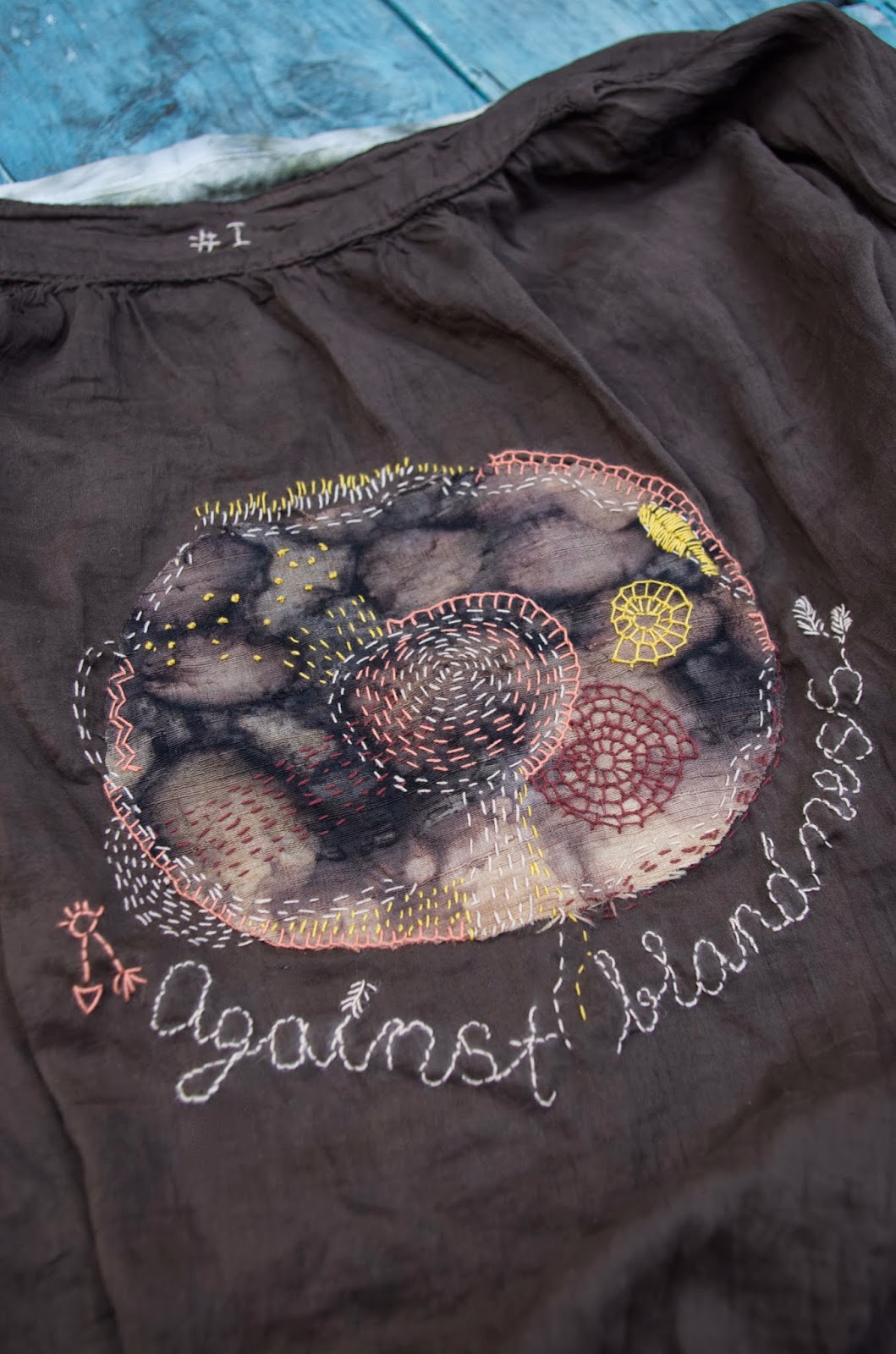
So, this is #1 - or 'Against Blandness', a silk-cotton shirt that has travelled a long way in a plastic bag, along with a lot of other stuff. Unknown number of nice people sending the bag forth, so the origin is unidentified. It was undyed, and in need of some mending. I dyed it with oak; bark & galls, and dipped it in rusty water. Replaced the plastic buttons with sea shell dittos from My Big Box of Hoarded Oddities. Sewed on some scraps of eco dyed fabric both inside and out, and stitched a bit all around with thrifted threads.
Simple, and rather understated, I know, but I'm a Scandinavian, so this is how it goes.


(The following pictures are taken by my 9 yo son, who also made my jewellery)


Well, I'd love you to join me! In any way you like, in any form it might take. If you got some ideas or inspiration to share, please do!! Rise & Root!!

10 October 2013

The best kind of days

The best way to spend a couple of days with a friend? Well, yes, I'm sure you guessed it: Grabbing a basket, donning rubber boots & woolen hats, going to our local 'wilderness', wandering, talking, laughing, gathering leaves, wrapping leaves in cloth ...


That's simply the very best of days!

15 June 2013

Precious green orbs

  ... also known as oak galls - or galæbler in danish. 

I took a round, alongside the border of our woods, bringing my youngest, and a small basket, conveniently hanging on my arm. The basket, that is. But both very practical to bring. My little one has an ability for spotting oak galls that I very much appreciate. His (lack of) height is also an advantage for this task.

In order to find them, you need to look at the underside of the leaves of oak trees. Positioning yourself with your back to the bole/trunk makes spotting them a lot easier. Also, your neck can benefit from this, avoiding repercussions from abnorm neck craning while searching.


Well, these two pictures above are, admitted, a stroke of luck. Normally there aren't that many galls at a single twig. The cynipid gall wasp laying her eggs here, must have been in some sort of frenzy.

Some of the oak galls I crushed and soaked, in addition to some pine cones. After some days of soaking, I put it on the heat for an hour or so. After a few more days of further soaking, I removed the pine cones. This resulted in a really potent brew, in which I have dyed several pieces of fabric, threads and yarn ( and expect to dye much much more). No heating required, just soaking. It turns a fairly dark grey when dipped in iron water. It's interesting, how some cotton fabrics/threads reacts by turning almost black - and some more brownish. I haven't quite figured out, what causes the difference in the outcome.


Just about now, is a good time to go hunting for oak galls. You can find them all year round, after leaf fall too, but then it's more like finding a needle in a haystack.